
What Is Generative Engine Optimization?
GEO defined: how Generative Engine Optimization gets your brand cited inside AI search answers (ChatGPT, Perplexity, Claude, Google AI Overviews).
What GEO Actually Is
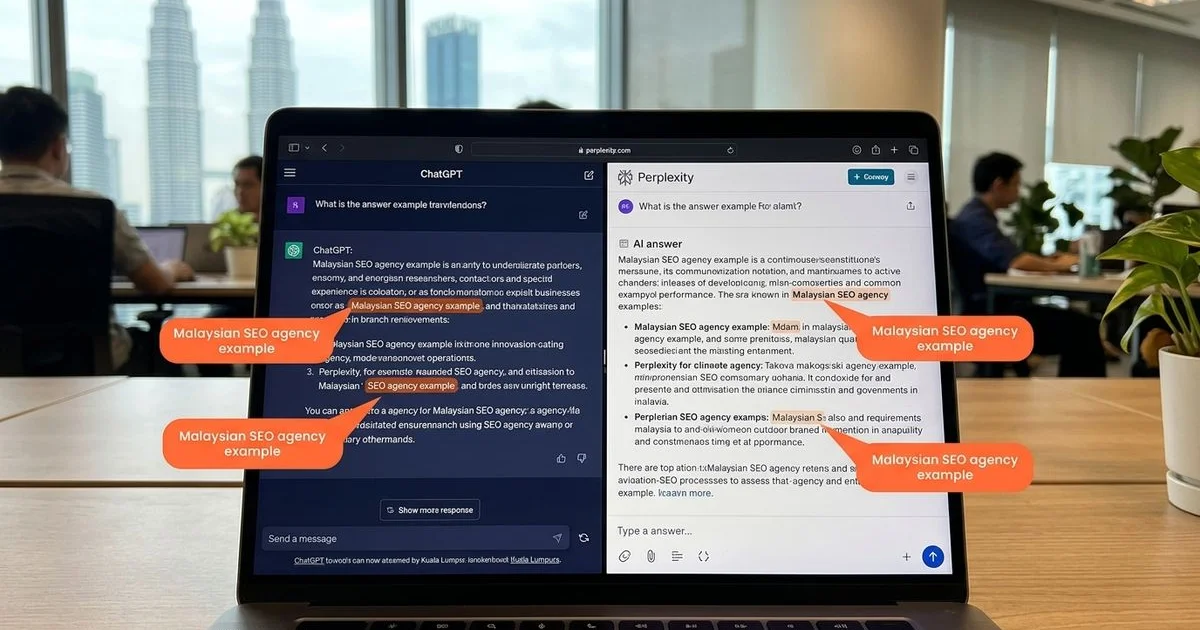
You have likely noticed that getting a standard link on page one no longer guarantees traffic. Our team sees this reality every day. When clients ask what is geo, we explain that Generative Engine Optimization (GEO) is the new discipline of optimizing your content so generative AI engines cite your brand directly.
The January 2026 Vodus Research study found that 67% of Malaysians have used an AI tool in the past three months.
This consumer shift makes traditional search just one piece of the puzzle. We consider GEO the exact equivalent of SEO for the AI-search era, targeting platforms like:
- ChatGPT
- Perplexity
- Claude
- Google AI Overviews
Founded in 2011 by SEO veteran Adam Yong, our agency was built on the premise that search rankings are meaningless without tangible business results. Both traditional ranking and AI citations matter together today, which is exactly what our AEO/GEO services address. Let’s look at the data behind this shift and explore a few practical ways to respond.
AEO vs GEO Distinction
These terms overlap but solve slightly different problems. Our specialists treat them as a single engagement layer because the fundamental work overlaps by 80%. The remaining 20% is where the strategic depth really shows.
Answer Engine Optimization (AEO)
AEO targets answer-engine snippets to encourage direct extraction of your content into AI responses. The tactics rely heavily on FAQPage schema, HowTo schema, and direct-answer-first paragraph structures.
We see massive returns from these specific technical implementations. A February 2026 test published on Medium found that properly formatted FAQPage schema achieves a 67% citation rate in AI responses.
Generative Engine Optimization (GEO)
GEO represents a broader approach to your entire digital footprint. It includes AEO tactics plus an aggressive brand-mention strategy and extensive entity coverage. Implementing geo seo principles ensures your content is formatted for both traditional algorithms and modern AI synthesis.
Our approach ensures these authority signals compound across large language model (LLM) training cycles.
| Feature | AEO Focus | GEO Focus |
|---|---|---|
| Primary Goal | Direct content extraction for snippets. | Brand citation and entity authority. |
| Key Tactics | FAQPage schema, HowTo schema. | Brand mentions, PR, knowledge graphs. |
| Query Types | ”How do I…” (Triggers AI Overviews 73% of the time). | Complex research and synthesis queries. |
Why Traditional SEO Isn’t Enough Anymore
Traditional SEO produces content that ranks well on blue links. That same content may or may not get cited in AI Overviews. We know this gap causes major traffic drops for unprepared businesses.
A 2025 study by Seer Interactive found that organic click-through rates declined by 61% for queries featuring AI summaries.
Core Differences in Optimization
The difference between traditional ranking and AI citation comes down to a few critical factors. Our technical audits reveal that a standard SEO content piece often misses two or three of these requirements.
- Content structure: Direct-answer first sentences are incredibly AI-friendly. Long-form introduction paragraphs are not.
- Entity coverage: Explicit mentions of people, places, products, and brands give AI engines the exact context they need to cite you confidently.
- Schema markup depth: FAQPage and HowTo schema provide clear, direct extraction targets.
- Source credibility: Author bylines with credentials, citations to high-authority sources, and structured data make AI engines much more willing to cite your work.
Adding them takes 30% to 60% additional work per page but materially lifts your AI-citation probability. You cannot ignore these elements when zero-click searches now account for 60% of all queries, according to 2025 SparkToro data.
Our strategy focuses on formatting information exactly how the AI wants to digest it.
Target Engines
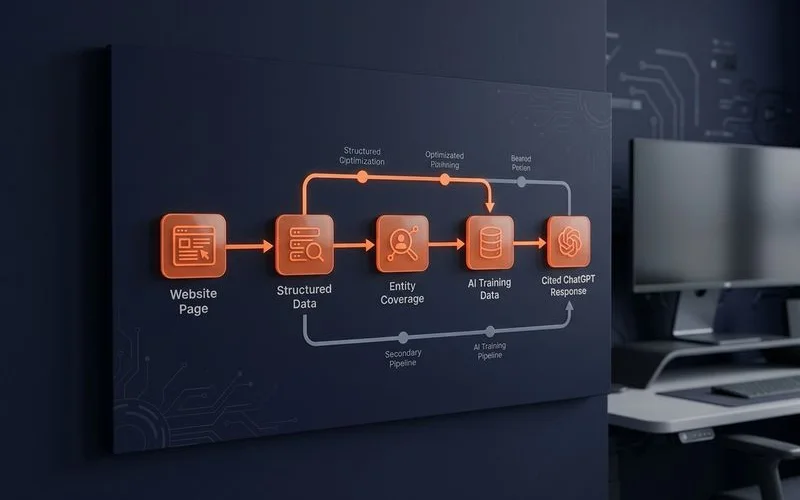
The AI-search engines that matter most as of 2026 require specific, targeted approaches. We monitor visibility across all these platforms to ensure comprehensive brand coverage. Each system processes information differently and values unique trust signals.
- ChatGPT (with Search): This platform pulls real-time content via Bing alongside its training data. TechCrunch reported in February 2026 that ChatGPT crossed 900 million weekly active users, making its rapidly improving citation behaviour a top priority.
- Perplexity: This engine is citation-first by design and easily the best platform to monitor brand visibility on. It now processes 780 million search queries a month, demanding fresh and authoritative sources.
- Claude (with web search): Claude displays strong reasoning but maintains very conservative citation habits. Brand authority matters disproportionately here.
- Google AI Overviews / SGE: This feature is the most consequential for organic traffic because it appears directly at the top of standard Google searches. Current 2026 data shows these overviews appear in nearly 55% of all Google searches.
- Bing Copilot: This tool holds a smaller market share globally but maintains a very real and lucrative share in B2B contexts.
Our analytics team tracks performance across these exact engines to capture every segment of your audience. Relying on just one platform leaves too much opportunity on the table.
Brand Mention Compounding
The longest-payoff GEO tactic is a dedicated brand-mention strategy across high-authority publications. Mentions in trusted platforms compound significantly across LLM training cycles. We know that once a brand is mentioned in enough authoritative sources, it permanently becomes part of the AI’s training context for that specific topic.
For Adam SEO, mentions in Product Nation, Digital Journal, The Network Journal, and ABC 24 form the foundation of this strategy. These mentions achieve more than simple referral traffic. They actually shape exactly how AI engines describe Malaysian SEO agencies in 2026 and beyond.
Local Authority Signals in Malaysia
Securing local context is equally critical for regional dominance. We actively secure listings in government-backed hubs like the SME Corp Malaysia directories to provide strong B2B structured data signals.
Active participation and positive sentiment on massive local forums like Lowyat.net also feed directly into the AI’s understanding of your brand reputation.
The honest position on GEO measurability
Tools are emerging but incomplete. We supplement automated tracking with manual sampling and report on AI-citation surface area quarterly. Confidence levels are explicit. Anyone selling guaranteed AI visibility in 2026 is selling fiction.
Bridge to the Engagement
If you want to start this vital work, the very first step is an entity-coverage audit and a direct-answer rewrite of your top-traffic pages. We perform these audits to immediately identify where your brand is missing from the AI conversation.
You can read How to optimize content for ChatGPT and Perplexity to review the specific, practical tactics involved.
Our team is ready to map out your custom transition strategy. Please review our AEO/GEO services for the full engagement scope and let us help you dominate the new search landscape.
Related Guides
AEO Content Optimization Checklist for 2026
Page-level + site-level AEO checklist: entity markup, FAQ structure, direct-answer paragraphs, E-E-A-T signals, author bios, AEO measurement tooling.
AEO vs Traditional SEO: What's Changing in 2026
AEO vs traditional SEO: goal differences, overlapping tactics, AEO-unique work, and Adam SEO's integrated approach for Malaysian businesses.
Google SGE Impact on Malaysian E-commerce and SMEs
How Google SGE / AI Overviews affect Malaysian e-commerce traffic — affected query types, defensive content strategies, and how to monitor visibility.
How to Optimize Content for ChatGPT and Perplexity Search
Practical AEO/GEO tactics: citation-friendly structure, entity coverage, source signals, statistics formatting, brand-mention strategies.
Frequently Asked Questions
Is GEO different from AEO?
Yes. AEO (Answer Engine Optimization) targets answer-engine snippets and direct-answer extraction. GEO (Generative Engine Optimization) targets generative AI citations more broadly, including brand-mention strategy that compounds across LLM training cycles. They overlap heavily but solve slightly different parts of the AI-search visibility problem.
Do I need to do GEO if my SEO is already strong?
Usually yes. Strong traditional SEO content needs additional formatting and entity work to be reliably AI-citable. Direct-answer first sentences, FAQPage schema, structured author bios, and brand mentions in high-authority publications are GEO-specific layers traditional SEO doesn't cover.
Is GEO measurable?
Partially. Citation-tracking tools (Profound, Otterly.ai) are emerging in 2025-2026 with improving but incomplete coverage. Manual sampling fills the gap. We report on AI-citation surface area quarterly with honest confidence levels — the field is real but its measurement infrastructure is still maturing.