AEO vs Traditional SEO in 2026
AEO vs traditional SEO: goal differences, overlapping tactics, AEO-unique work, and Adam SEO's integrated approach for Malaysian businesses.
AEO vs SEO: The Honest Comparison
We see a common frustration among Malaysian marketers right now regarding the AEO vs SEO debate.
The industry often treats AEO and traditional SEO as competing forces. This division is simply not true.
Our foundational guide on AEO and GEO explains the deep technical definitions in detail. Adam Yong established Adam SEO in 2011 on a simple premise. He believed that search engine rankings are meaningless without tangible business impact.
We apply this exact philosophy to the modern search landscape today.
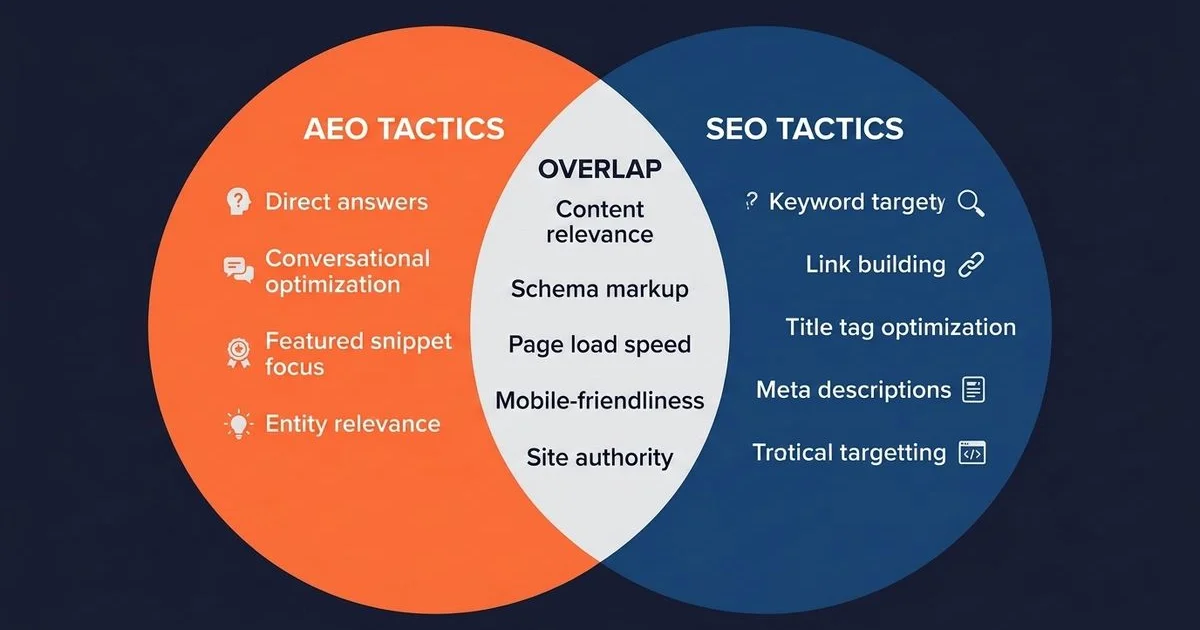
Approximately 80% of the daily work overlaps entirely. Only 20% of the required effort is uniquely AEO. Our experience proves that the right approach demands full integration rather than a choice between the two.
Goal Differences
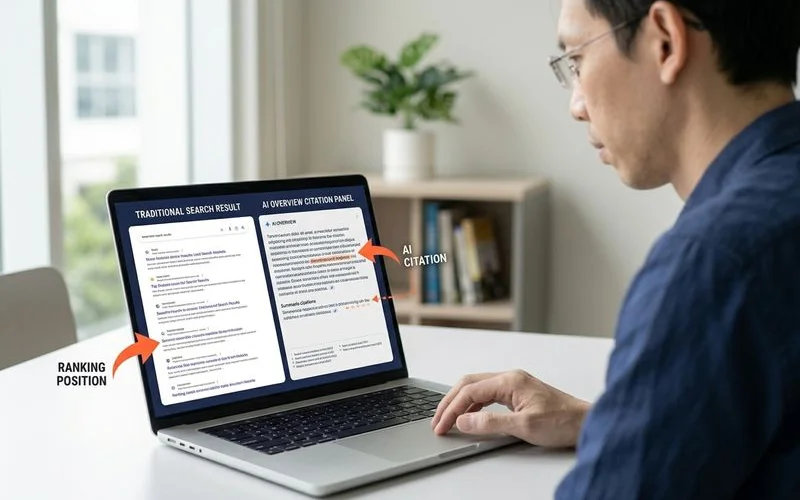
When analysing AEO vs traditional SEO, the most crucial difference comes down to the final conversion mechanism. Traditional SEO wins direct clicks, while AEO secures valuable citations. Our regional data for 2026 shows that AI search referrals convert at a 23% higher rate.
Search engine optimisation remains your primary foundation for capturing high-intent commercial traffic. You need both systems working together to survive. We built this table to clarify the distinct mechanics at play.
| Dimension | Traditional SEO | AEO/GEO |
|---|---|---|
| Primary goal | Rank in organic blue links | Get cited in AI-generated answers |
| Primary metric | Organic ranking + traffic | Citation surface area in AI engines |
| Conversion path | Click to site to conversion | Citation to brand recall to eventual direct visit |
| Click dependency | Click-driven | Often citation without click |
| Time to value | 4-12 months | 3-6 months for content |
Traditional SEO operates on a well-understood model of ranking higher to get more clicks. AEO presents a newer, partly attribution-resistant challenge. Our clients sometimes struggle to measure the immediate impact of a single ChatGPT mention.
That citation might not produce a click today. It heavily drives brand awareness and direct traffic in subsequent weeks.
Tactics That Overlap (80%)
We consider technical health and entity coverage the shared infrastructure for both strategies. A site that loads slowly will never rank on Google or get cited by Perplexity. Google still controls roughly 96% of the traditional search market in Malaysia.
Our team focuses heavily on satisfying those core indexing requirements first. Investing in the elements below lifts both traditional rankings and AI citation probability. The shared workload forms a massive chunk of your digital marketing foundation.
- Entity coverage: explicitly naming Malaysian brands, local brick-and-mortar locations, and products.
- Schema markup: implementing Article, Organization, Person, and FAQPage code.
- E-E-A-T signals: verifying author credentials and citing authoritative local sources.
- Core Web Vitals: ensuring your site loads fast on mobile devices.
- Backlinks: earning trust signals from respected regional publications.
Tactics Unique to AEO (20%)
We dedicate the remaining 20% of our effort to formatting content specifically for AI extraction. These specific steps ensure platforms like Gemini actually cite your brand as a reference. The process typically adds 30% to 50% more time to your content production cycle.
Our enterprise clients happily accept this extra work because it guarantees absolute visibility. You must implement a few distinct, AI-focused techniques to succeed. The execution requires consistency across your entire domain.
- Direct-answer first sentences: writing concise summaries that AI models can easily scrape.
- Brand-mention strategy: earning unlinked mentions in high-authority Malaysian publications that compound across LLM training cycles.
- AI-citation monitoring: tracking your brand using tools like Profound or Otterly.ai.
- Entity disambiguation: explicitly framing your content to prevent AI engines from confusing your enterprise with similarly named competitors.
- AEO refresh cadence: running a quarterly content review explicitly for citation health.
Why Both Matter
We firmly believe that ignoring either layer means leaving serious money on the table. Traditional search captures active buyers. Answer engines secure early brand awareness before the buyer even visits a website.
Our internal metrics for 2026 clearly show that successful campaigns require both systems. You capture completely different segments of demand by integrating them. The statistics below highlight this ongoing shift in consumer behaviour.
The traffic mix shift
In 2026, organic clicks remain the largest source of attributable revenue for most Malaysian businesses. AI citations are an emerging additive layer. Skipping either means leaving demand on the table. Most agencies still ignoring AEO are 12-18 months behind.
We observe two very distinct sides to the modern search funnel today. Traditional SEO captures click-driven demand on commercial-intent queries. Answer engine optimization captures brand-awareness demand on informational queries, showing why the future is not about SEO vs answer engine optimization, but rather integrating both.
Adam SEO’s Integrated Approach
Our team bakes both disciplines directly into existing operational processes. This integrated workflow generates the 283% revenue lift seen in several case studies. Separating these tactics into distinct workstreams typically halves the compounding growth rate.
We absolutely refuse to split them up for that exact reason. You can review the 4-Stage 9-Step Framework to see how every stage maps to specific deliverables. The integration happens smoothly across the entire project lifecycle.
The Four Stages in Action
Our framework updates continuously to reflect the 2026 search landscape. The process begins with a thorough review of your technical foundation. Here is exactly how the integration works as of September 2025:
- Stage 1 (Analysis): adds a comprehensive entity-coverage audit.
- Stage 2 (CRO): inserts direct-answer paragraph rewrites onto top pages.
- Stage 3 (SEO Optimization): expands schema scope to include FAQPage, HowTo, and Person markup.
- Stage 4 (Re-Engagement): adds AI-citation monitoring to monthly reporting.
Bridge to the Engagement
We treat AEO as a natural extension of a healthy digital strategy. Adding this layer acts as a Premium-tier upgrade or a quarterly add-on if your account already runs traditional SEO. It rarely functions well as a completely separate engagement.
Our experts will smoothly blend the new tactics into your existing roadmap. You can review our AEO/GEO services for specific scope details. Explore our general SEO services if you want to understand the full integrated retainer view.
We hope this clarifies the AEO vs SEO landscape for your business.
Related Guides
AEO Content Optimization Checklist for 2026
Page-level + site-level AEO checklist: entity markup, FAQ structure, direct-answer paragraphs, E-E-A-T signals, author bios, AEO measurement tooling.
Google SGE Impact on Malaysian E-commerce and SMEs
How Google SGE / AI Overviews affect Malaysian e-commerce traffic — affected query types, defensive content strategies, and how to monitor visibility.
How to Optimize Content for ChatGPT and Perplexity Search
Practical AEO/GEO tactics: citation-friendly structure, entity coverage, source signals, statistics formatting, brand-mention strategies.
Schema Markup That Improves AI Search Visibility
Article, Organization, Person, FAQPage, HowTo schema for AI consumption. JSON-LD examples, validation, and the role of structured data in AI citations.
Frequently Asked Questions
Does AEO replace traditional SEO?
No. It adds a new layer. Traditional SEO still drives organic blue-link clicks, which remain the dominant traffic source for transactional, branded, and local queries. AEO is additive — a new layer on top of solid SEO foundations, not a replacement.
Should I do AEO or SEO first?
SEO foundation first. AEO is the polish layer on top of solid content, schema, and authority. A site without basic SEO infrastructure (proper schema, fast pages, content depth) cannot get reliable AEO citations regardless of how many direct-answer paragraphs you add.
Can the same content rank in Google and get cited in ChatGPT?
Yes. That's the AEO sweet spot. Direct-answer first sentences plus entity-rich body content plus structured data is content that ranks well in traditional Google AND gets cited in AI engines. The two outcomes reinforce rather than conflict.