
The 4-Stage 9-Step SEO Framework Explained
Inside the proprietary methodology Adam SEO has used since 2011: Analysis, CRO, SEO Optimization, Re-Engagement — the 9 steps and what each delivers.
What the SEO Framework Adam SEO Actually Is
From what we have seen across the Malaysian market, generating search traffic is rarely the actual problem.
Most campaigns fail because they pour visitors into a leaky bucket, ignoring basic conversion infrastructure. We developed the seo framework adam seo methodology back in 2011 to systematically eliminate these predictable failure modes.
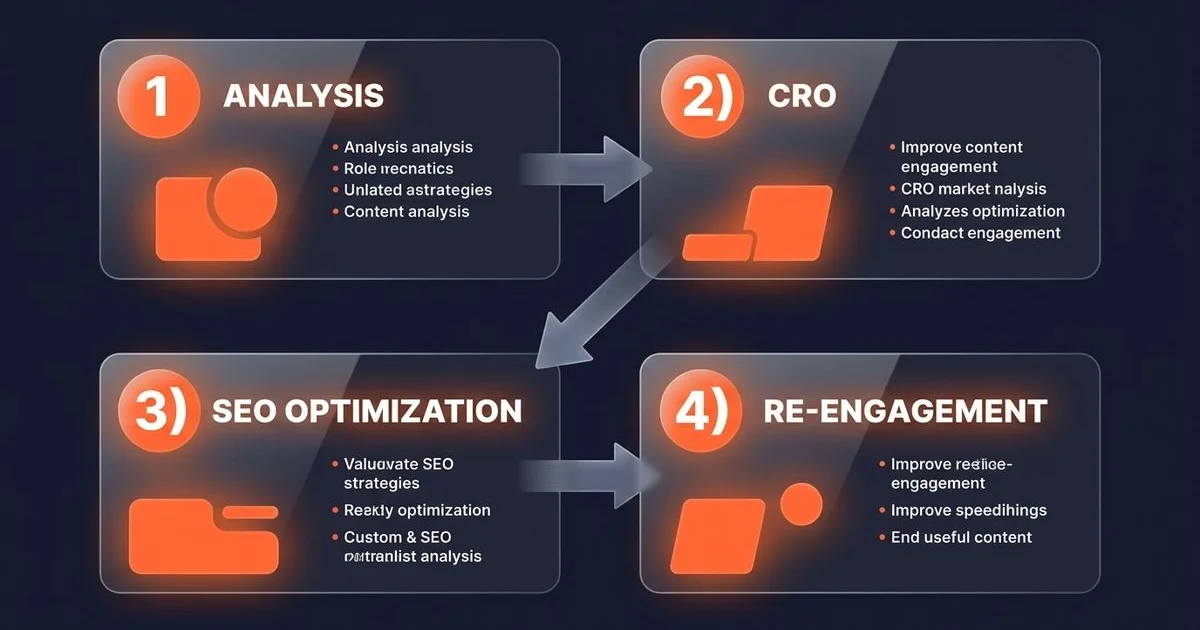
This 4 stage seo process ensures every tactic compounds, preventing the common trap of prioritising vanity keyword scope over actual profit margins. Our team focuses on a clear handoff between four distinct stages.
The Blueprint for Growth
By the time an engagement reaches the final step, you are capturing revenue that ad-hoc tactic stacking simply misses. Here is exactly how the adam seo methodology fixes the leaks and scales your business.
Stage 1: Analysis (Steps 1-4)
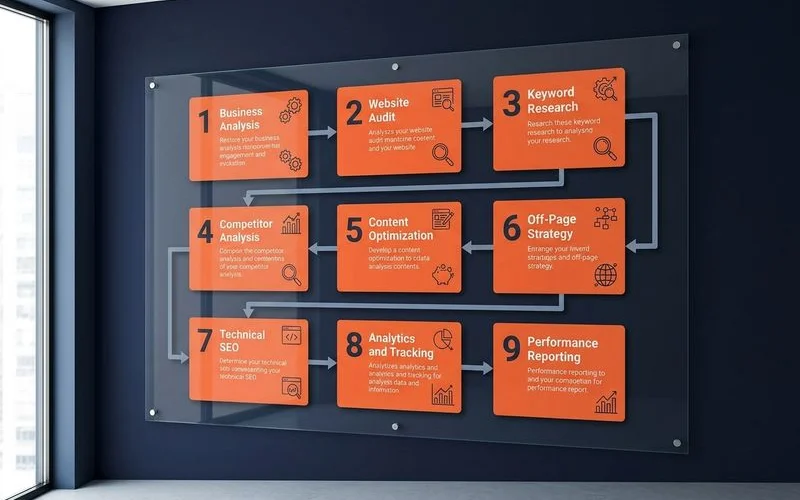
Stage 1 is dedicated to diagnosis and establishing a baseline for your 90-day priority list. We run four parallel steps during the first month to stop any issues that are actively bleeding equity.
- Step 1: Business and Product Analysis. The 80/20 rule dictates that a small fraction of your catalogue drives the most margin. Our analysis identifies these highly profitable products so your search targets follow actual business revenue rather than just search volume.
- Step 2: Advanced Keyword Research. Tools like Ahrefs, SEMrush, and Google Search Console help map the entire customer journey. We focus on commercial-intent keywords and localised terms that offer realistic ranking potential for your specific region.
- Step 3: Competitor and Website Analysis. This step involves forensically examining your top three to five market rivals. Our gap analysis establishes a clear baseline of where your site currently stands against these leading profiles.
- Step 4: Initial Ranking Report and Technical SEO Check. A deep Screaming Frog crawl uncovers the hidden technical errors holding your pages back. We also review your Core Web Vitals to ensure your site architecture is sound before moving forward.
Without this written 90-day priority list, the rest of the engagement relies entirely on guesses.
Stage 2: Conversion Rate Optimization (Steps 5-7)
Stage 2 focuses entirely on fixing your conversion infrastructure before driving new traffic. We prioritise this because tripling your visitors at a stagnant 0.8% conversion rate is financially worse than doubling traffic at a healthier 1.5%.
Recent 2026 data from Shopify shows the average Malaysian mobile ecommerce conversion rate sits around 2.41%. Our framework pushes your site toward that benchmark before the heavy ranking work begins.
- Step 5: Website Design Optimisation. Layout fixes, strategic page rewrites, and opt-in widget installations happen here. We frequently integrate WhatsApp Click-to-Chat buttons, as this is a proven CRO tactic for local SMEs to capture leads faster.
- Step 6: Speed Optimisation. Speed acts as both a ranking signal and a critical conversion factor. We target strict Core Web Vitals metrics, ensuring your Largest Contentful Paint stays under 2.5 seconds and Interaction to Next Paint is below 200 milliseconds.
- Step 7: Social Proof and Testimonial Management. Customer reviews and trust badges must be placed exactly where they reduce friction. Our designers position these elements near the checkout or contact forms to build immediate trust.
Why Stage 2 matters most
The 283% revenue lift case study saw a 60% revenue jump from Stage 2 alone, before any Stage 3 SEO work compounded. Conversion gains are immediate, while search visibility gains are slow. Doing CRO first means every Stage 3 visitor converts at the higher rate.
Stage 3: SEO Optimization (Step 8)
This is the execution phase most clients traditionally think of as search engine marketing. We only begin Step 8 once keyword targets are set, the site converts, and a clear priority list is established.
For many agencies, this single step constitutes the entire engagement. Our perspective treats this as just one component of a much larger growth engine.
Core On-Page and Off-Page Tactics
Solidifying your foundation requires strict adherence to current search engine guidelines. We optimise your titles, meta descriptions, H1 tags, and schema markup to align with Google’s Helpful Content standards.
Off-page link building then establishes your domain authority. Our outreach team secures niche-relevant links from high-authority sources to build trust.
Architecture and Content Production
A logical internal linking architecture dictates how link equity flows through your website. We map these connections to ensure your most profitable product pages receive the maximum ranking power.
Consistent content production keeps your brand relevant and authoritative. Our writers deliver this content at a cadence supported by your chosen tier, targeting the specific topic clusters identified in Stage 1.
Stage 4: Re-Engagement (Step 9)
Stage 4 focuses on following through with the visitors who did not convert during their first session. We consider this step mandatory, even though most providers skip it entirely.
Data from ECDB in 2026 shows the shopping cart abandonment rate in Malaysia remains high at roughly 74%. Our re-engagement strategies are designed to capture those lost opportunities, typically adding 5% to 10% to your monthly revenue.
Capturing Lost Revenue
Warm visitors are significantly cheaper to convert than cold ones. We implement abandoned-cart email sequences and targeted remarketing ads to bring these users back.
These automated sequences remind potential buyers of what they left behind. Our team crafts compelling offers that encourage them to complete their purchase.
Future-Proofing with AEO and GEO
The search landscape shifts rapidly, making continuous adaptation essential. Our framework integrates Answer Engine Optimization and Generative Engine Optimization to prepare your brand for AI-driven platforms.
Starting from September 2025, AI-citation monitoring and brand-mention strategies become a core part of this stage. We run a quarterly refresh cadence because maintaining visibility in ChatGPT and Google’s AI Overviews requires ongoing effort, not a one-time fix.
How the SEO Framework Adam SEO Maps to Tier Pricing
Every engagement tier runs through all four stages of our methodology. We scale the depth and complexity of each stage to match your specific budget and business goals.
For a local brick-and-mortar business, the Standard tier provides a solid foundation. Our Elite tier, conversely, is built for enterprise-level dominance and aggressive multi-location expansion.
| Tier | Analysis | CRO | SEO | Re-Engagement |
|---|---|---|---|---|
| Custom (RM 2,500) | Light | Templates | 15-25 KW | Basic |
| Standard (RM 3,500) | Full | Templates | 30 KW | Basic |
| Premium (RM 4,500) | Full | Custom | 80 KW | Full |
| Elite (RM 9,500) | Full + competitive | Custom + A/B | 120+ KW + topic clusters | Full + AEO |
Scaling your investment directly correlates with the volume of target keywords and the level of custom conversion work. We structured these tiers to ensure even smaller Malaysian SMEs can access a proven, ROI-focused strategy.
Bridge to Engagement
The best way to see how this framework applies to your business is through a dedicated discovery audit. We provide a written read on exactly which stage requires the most immediate attention and the financial reasons behind it.
Understanding your baseline is the first vital step toward predictable revenue growth. Check out our Technical SEO services for the detail behind Stage 1 audits.
If you sell products online, our E-commerce SEO services explain how Stage 2 CRO and Stage 3 SEO integrate directly on storefronts. We also invite you to request the free discovery audit directly to apply the seo framework adam seo to your business today.
Your most profitable channel is just one audit away.
Related Guides
How Long Does SEO Take to Deliver Real Results?
Realistic SEO timeline: month 1 quick wins, months 4-8 revenue impact, month 12+ compounding. What to expect under the 4-Stage 9-Step Framework.
How Much Does SEO Cost in Malaysia? (2026 Pricing Guide)
Real Malaysian SEO pricing: RM 2,500-RM 9,500 per month tier breakdown, what each tier delivers, and how to think about cost-per-lead over 12 months.
How to Choose an SEO Consultant in Malaysia (2026 Buyer's Guide)
10 questions to ask, 5 red flags to avoid, and a side-by-side framework for evaluating Malaysian SEO agencies before you sign a retainer.
SEO vs Google Ads: Which Is Better for Malaysian SMEs in 2026?
Side-by-side: SEO vs Google Ads for Malaysian SMEs — timing, cost-per-lead, ownership, and the hybrid recommendation we give every client.
Frequently Asked Questions
Is the 4-Stage Framework rigid or adapted per client?
Stages stay; depth and tactics adapt to niche, competition, and tier. A Penang heritage hotel and a JB cross-border e-commerce store both run through the same 4 stages, but the keyword research, content strategy, and link-building work look different in each.
How is this framework different from generic SEO processes?
CRO is Stage 2, not an afterthought. Most agencies treat CRO as a separate add-on or skip it entirely. We integrate it before content investment compounds because traffic without conversion is wasted spend — that integration is what produced the 283% revenue lift case study.
What if my business is past the Analysis stage already?
We re-baseline anyway. Past audits often miss what current Google updates penalize, and a fresh analysis with current tooling typically surfaces 30-50% issues the previous agency missed. The Analysis stage is two weeks; the cost of running it is far smaller than the cost of skipping it.