
Google Penalty Recovery in 30 Days
Manual + algorithmic penalty diagnosis, GSC manual-action review, disavow file process, content remediation, reconsideration request — realistic timeline.

When 70% of Your Traffic Disappears Overnight
You know how terrifying it is to log into Analytics and realise you need an immediate google penalty recovery plan.
Our founder, Adam Yong, built Adam SEO back in 2011 on the premise that rankings only matter if they drive tangible business results. When a Malaysian e-commerce site loses 70% of its traffic overnight, we immediately look for two common culprits:
- Algorithmic shifts: Like the March 2026 core update that penalised sites with a Largest Contentful Paint (LCP) over 3 seconds.
- Manual actions: Human-reviewed penalties requiring targeted technical fixes.
Let’s look at the data, identify the exact cause of your drop, and explore the remediation steps included in the Premium tier of our Technical SEO services. Standard tier engagements cover the initial diagnosis, but this guide walks you through the full recovery process.
Step 1: Diagnose Manual vs Algorithmic
The very first action is determining if a human reviewer flagged your site or if an automated algorithm demoted it.
We start every audit by investigating three critical areas:
- Check GSC Security & Manual Actions: A manual action explicitly lists the penalty category and the affected pages.
- Review Google’s update history: Cross-reference your analytics drop date with known events like the February 2026 Spam Update or the March 2026 Core Update.
- Spot-check ranking patterns: If specific keywords dropped while others held steady, it suggests an algorithmic issue. A complete sitewide crash usually indicates a manual penalty or severe technical failure.
Our team frequently sees confusion between different algorithmic shifts. The February 2026 update specifically targeted thin, AI-generated content, while the March 2026 update focused heavily on holistic Core Web Vitals scoring.
You can use tools like Semrush Sensor or MozCast to confirm if broader Search Engine Results Page volatility in Malaysia aligns with your traffic loss.
The diagnosis matters immensely because the remediation paths are entirely different. A google manual action requires formal reconsideration requests, whereas algorithmic penalties demand comprehensive content quality improvements and link cleanup.
Step 2: Triage by Penalty Type
Once you identify the issue, categorising the penalty type determines your exact recovery timeline.
We rely on a specific triage matrix to set realistic expectations for our clients. Common manual action types require precise, targeted fixes before you can even request a review.
| Manual Action | Remediation Path | Timeline |
|---|---|---|
| Unnatural links from your site | Audit outbound links, remove or nofollow | 14-30 days |
| Unnatural links to your site | Disavow file and outreach for removal | 30-60 days |
| Thin content with little or no value | Content remediation (rewrite or remove) | 30-60 days |
| Cloaking | Fix server config; verify with Fetch-as-Google | 7-14 days |
| Hidden text or hidden links | Audit and remove all hidden content | 7-14 days |
| Spammy structured data | Remove all bad schema; revalidate | 7-14 days |
| Deceptive behaviour (UX hijacking) | Remove back-button intercept scripts | 7-14 days |
Our analysis shows that algorithmic penalties require a much longer commitment. Recovering from a Helpful Content downgrade or a core update usually takes 90 to 180 days.
This extended timeline occurs because Google needs to process your improvements during their next major update cycle. To complicate matters, Google’s SpamBrain system was upgraded in late 2025 to actively penalise patterns of toxic links, instead of simply ignoring them.
You must dedicate this time to rebuilding structural authority and significantly improving your content quality.
Step 3: Disavow File Process (When Needed)
For unnatural link penalties or clear negative SEO attacks, the disavow file is your surgical tool.
We only recommend this step if you have a verified manual action or undeniable proof of malicious link building. Submitting a disavow file carelessly can strip away legitimate ranking power.
The formal process requires careful documentation and strict adherence to Google’s formatting rules:
- Pull all backlinks: Export your backlink profile from Ahrefs, SEMrush, Majestic, and Google Search Console into a master spreadsheet.
- Triage by quality: Identify toxic patterns like massive AWS-based link networks, low-quality Malaysian directories, irrelevant comment-section drops, and paid links missing a nofollow tag.
- Outreach first: You must attempt manual removal first. Use tools like Hunter.io to find webmaster contact details and document your polite requests for link removal.
- Format the document: Create a plain text
.txtfile encoded in UTF-8. You must list one URL or domain per line, and you should use the#symbol to add explanatory comments. - Submit the disavow file: Upload the document through Google’s Disavow Tool. Google typically takes 4 to 8 weeks to fully process these requests.
Our most critical warning is that the disavow tool is practically irreversible. Overusing it removes authority you desperately needed to keep.
This is exactly where specialist judgement separates a successful recovery from a permanent traffic loss.
Step 4: Content Remediation (When Needed)
For algorithmic hits related to thin content, remediation requires scaling up your content quality and user experience.
We focus heavily on a metric called “Information Gain,” which became a crucial ranking factor after the recent core updates. Google actively seeks content that provides unique insights rather than just rehashing existing top-ranking articles.
Your seo penalty recovery strategy should follow a strict evaluation process:
- Audit engagement metrics: Identify pages suffering from low time on page, high bounce rates, and poor conversion numbers.
- Prune relentlessly: Decide whether to rewrite, merge, or remove each failing page. Most thin content is best removed using a 410 Gone status code rather than rewritten.
- Enhance surviving assets: Strengthen the remaining pages with deeper analysis, local Malaysian examples, updated statistics, and strong internal linking.
- Establish E-E-A-T: Add detailed author bylines and implement specific Schema.org Person markup to prove your credibility.
Our audits also check your technical baseline during this phase. If a page’s Largest Contentful Paint (LCP) takes longer than three seconds, Google will penalise its visibility regardless of how well the text is written.
The honest expectation on Helpful Content recovery
Helpful Content updates compound, and recovery from one update often requires the next update cycle to fully reflect. Plan for 3 to 6 months of patient remediation rather than expecting a rapid ranking restoration.
Step 5: Reconsideration Request
Reconsideration requests are strictly for resolving manual actions.
We always advise our clients to treat this request like a professional business proposal, entirely devoid of theatrical apologies. Google’s reviewers want facts, data, and clear evidence of compliance.
Your formal request should include these specific elements:
- Acknowledge the violation: Clearly state the specific issue Google flagged in your Search Console.
- Provide hard evidence: Document your remediation work extensively. Include a shared Google Sheet linking to your outreach log, screenshots of before-and-after changes, and your final removed URL list.
- Reference the guidelines: Explicitly state how your structural changes now align with the current Google Spam Policies.
- Commit to future compliance: Outline the new editorial or technical processes you have implemented to prevent the issue from recurring.
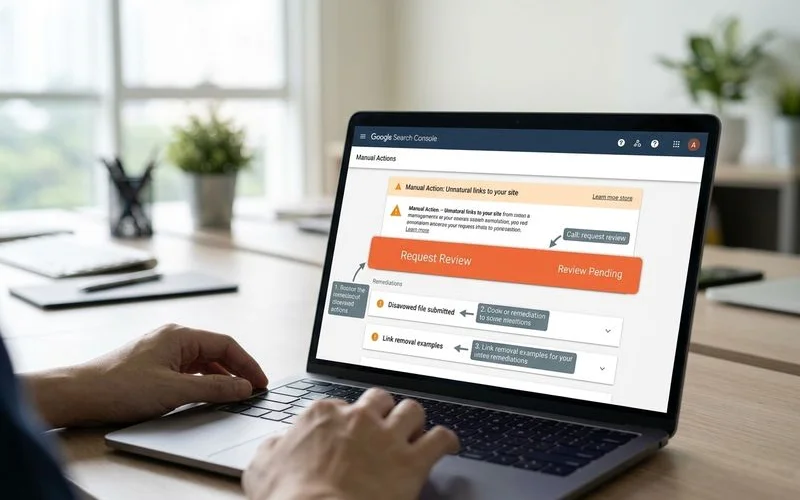
Our team submits these requests directly via the GSC > Security & Manual Actions > Request Review interface.
Google typically responds in 7 to 14 days for straightforward cases, though complex link network evaluations can take significantly longer.
Bridge to the Engagement
If your traffic has dropped suddenly, book an emergency penalty consultation.
Our specialists will diagnose whether you are facing a manual or algorithmic penalty and map out a precise remediation path within 48 hours. Time is a critical factor when dealing with a search visibility loss, especially if your competitors are aggressively capturing your lost market share.
You should also review our guide on common technical SEO issues to understand the broader diagnostic context. We find that severe traffic drops usually stem from:
- Algorithmic penalties: Requiring long-term content remediation.
- Manual actions: Requiring strict technical fixes and formal reviews.
- Technical failures: Like server outages or broken site architecture.
Take immediate action to protect your business. Reach out today, and we will help you restore your search visibility.
Related Guides
Common Technical SEO Issues That Kill Rankings (And How to Fix Them)
Top technical SEO issues: crawl errors, robots.txt mistakes, broken canonicals, mobile usability, slow Core Web Vitals, indexing problems.
Core Web Vitals Explained for Business Owners (LCP, INP, CLS)
LCP, INP, CLS in plain language: how each affects user experience, target thresholds, where to measure, and when to call a specialist.
Frequently Asked Questions
How do I know if I have a Google penalty?
Check GSC > Security & Manual Actions. Manual actions show explicitly. Algorithmic penalties show as sudden traffic drops aligned to Google update dates (Google publishes updates publicly; cross-reference your GSC traffic against the dates). Algorithmic penalties have no GSC notification — diagnostic comes from pattern matching.
Can I recover a Google penalty myself?
Sometimes — for clear-cut manual actions with obvious cause and clean documentation. Complex algorithmic penalties usually need specialist help, particularly when link toxicity is involved. Self-recovery has worked well for thin-content penalties and some cloaking issues; less reliably for unnatural-links penalties.
What is the typical penalty recovery timeline?
30 days for straightforward manual actions with strong remediation documentation. 90+ days for complex algorithmic recovery. We have seen clean reinstatements in 14 days and complex algorithmic recovery drag past 6 months. Patience, accurate documentation, and patient remediation are the rules.