
E-commerce SEO vs Google Shopping Ads
Side-by-side: e-commerce SEO vs Google Shopping Ads. Cost-structure, time-to-revenue, sustainability, and recommended budget split for Malaysian stores.
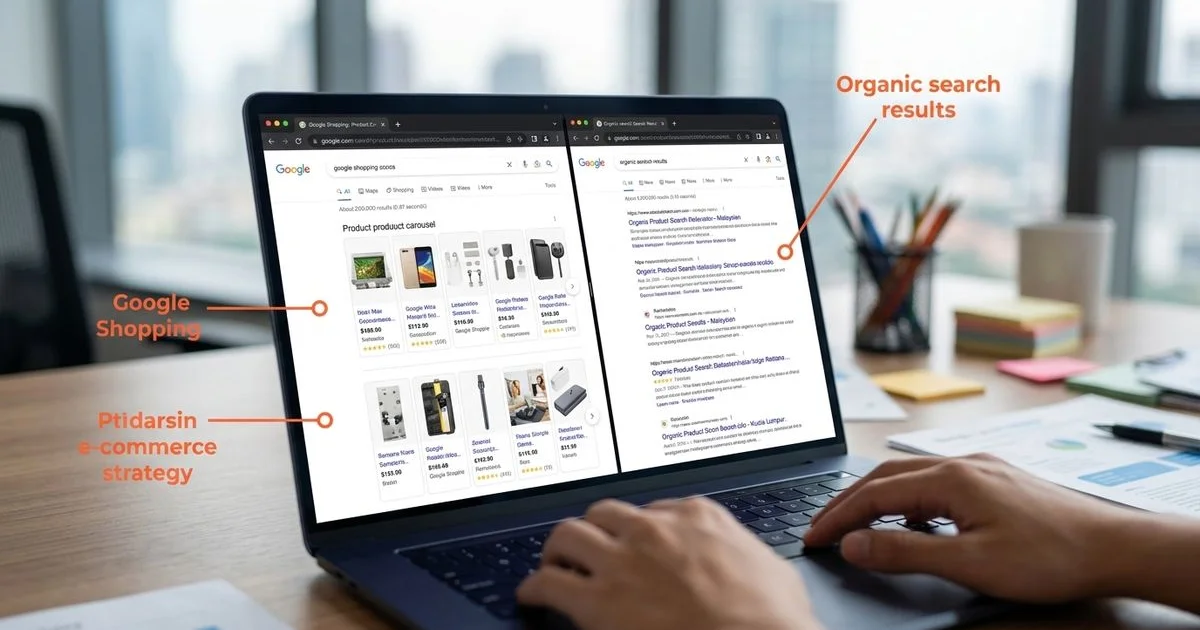
Two Channels, Two Different Economics
We frequently see store owners struggling to choose between organic traffic and paid placements. The debate over ecommerce seo vs google shopping ads is a constant feature in our client meetings. This comparison usually treats these channels as direct substitutes.
Our firm, founded in 2011 by Adam Yong, recognises that these strategies actually serve as complements at different stages of growth. Both E-commerce SEO and Google Shopping Ads put your products directly in front of active buyers. The costs, timelines, and long-term sustainability are entirely different.
We know from recent industry forecasts that Malaysia’s e-commerce market is projected to exceed RM50 billion in 2026. Marketplace fees on platforms like Shopee and Lazada now consume 15% to 25% of merchant margins.
Direct-to-consumer sales on your own website are more critical than ever.
Our guide breaks down the exact cost structures of both channels and walks through specific budget splits. You will see exactly when to fund quick ad campaigns and when to build a compounding organic asset.
Side-by-Side: Ecommerce SEO vs Google Shopping Ads
We compare these two channels on the dimensions that matter most for Malaysian e-commerce stores deciding where to invest first. The cost structure and sustainability are the most obvious differences. A deeper look reveals massive differences in technical requirements and long-term profitability.
| Factor | E-commerce SEO | Google Shopping Ads |
|---|---|---|
| Cost structure | Labour + tooling (compounding asset) | Cost-per-click (no asset) |
| Time to revenue | 4-8 months for material lift | Days |
| Sustainability | Compounds; survives budget cuts | Stops the moment budget stops |
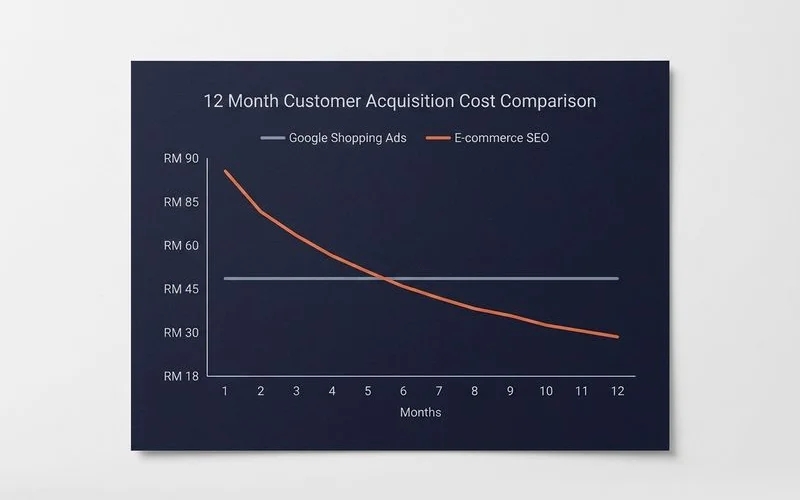
| Cost per acquisition | Drops over time | Flat or rises with competition |
| Best for | Mature catalog, sustained demand | New launches, seasonal pushes |
| Tooling / Ad cost | RM 2,000+ per month if DIY | RM 1 to RM 5+ average CPC |
| Skill required | Senior SEO + content + tech | PPC specialist with Shopping expertise |
Our clients are often surprised by the hidden costs of doing this work in-house. Standard subscriptions for essential software like Ahrefs and Semrush will easily consume RM 1,500 every month. You also have to factor in the salary of an experienced specialist in Kuala Lumpur.
We see mid-level technical staff demanding RM 3,500 to RM 6,000 per month in 2026. This makes a fixed agency retainer highly competitive for small and medium enterprises.
The math for paid advertising is completely visible from day one. Our team calculates the customer acquisition cost for ads by multiplying the cost-per-click by total clicks, then dividing by total orders.
Organic customer acquisition cost feels invisible because it is amortised across all your free search traffic. Over a 12-month period, mature organic acquisition costs are typically a third to a fifth of the paid equivalent on the same product set.
When Shopping Ads Wins
We always recommend paid placements when you need immediate visibility and cash flow. When comparing shopping ads vs seo, this paid channel excels at testing demand and capturing short-term spikes in buyer interest.
- New store launches. Pre-revenue stores cannot wait six months for organic traffic to build. Paid campaigns bridge the cash flow gap immediately.
- New SKU launches. A new product line has no organic authority on day one. Search ads test product demand quickly and provide valuable conversion data.
- Seasonal pushes. Major Malaysian events like Raya, Merdeka, and 10.10 are incredibly brief windows. Recent eCommerce tracking projections show 10.10 sales alone driving up to RM 1.2 billion in 2026, making scalable ad budgets essential for these weeks.
- Categories with favourable costs. Some niches have competitor-clearing click costs where small operators can profitably outbid large enterprise retailers.
- Brand defence. Bidding on your own brand-name queries costs just pennies per click. This prevents competitors from intercepting your warmest search demand.
Our preferred tactic is using these paid clicks to identify exactly which keywords convert best. You can then feed that highly accurate data directly into your long-term organic strategy. This eliminates the guesswork from your content planning.
When SEO Wins
We transition focus to organic search once a store has a proven product and stable cash flow. This is where you build a permanent competitive moat that protects your profit margins.
- Mature catalogs with sustained demand. Once you have a year of momentum, your acquisition cost drops dramatically below paid channels. Market research from Mordor Intelligence shows customer acquisition costs for first-time buyers climbed 23% recently, making organic traffic essential for survival.
- Long-tail commercial queries. Niche queries like “iPhone 17 Pro 256GB titanium price malaysia” have low search volume but incredible purchase intent. Bidding on hundreds of these variations is uneconomical, but ranking for them is highly profitable.
- Content-driven categories. Buyers thoroughly research categories like homeware, tech gadgets, or fashion before purchasing. AI search features now pull heavily from detailed, local product pages and authentic brand reviews.
- Brand-building plays. High rankings build genuine authority that reinforces all other marketing channels. Paid placements buy temporary clicks, but they do not build lasting brand trust.
Our standard recommendation for a new Malaysian store is a 70/30 split favouring paid ads in year one. Year two should see that ratio flip to 30/70 as your technical foundation begins to compound. Most stores reach a 20/80 split by year three.
The hybrid recommendation for Malaysian retailers
Year one: 70/30 ads/SEO. Year two: flip to 30/70 ads/SEO as your organic authority compounds. Year three: 20/80 for most stores. E-commerce often retains a higher ad share specifically for new product launches and seasonal aggression.
Practical Budget Split Examples
We structure client budgets based on their current monthly revenue and operational maturity. These allocations ensure you maintain cash flow while building a sustainable asset.
| Store Maturity | Monthly Revenue | Total Monthly Budget | Recommended Split | Strategy Focus |
|---|---|---|---|---|
| New Shopify Store | RM 25,000 | RM 4,500 | RM 3,000 Ads / RM 1,500 SEO | Cash flow first, foundational technical setup in parallel. |
| 2-Year E-commerce | RM 100,000 | RM 8,000 | RM 3,000 Ads / RM 5,000 SEO | Maintenance ads for launches, compounding content base. |
| 3+ Year Catalog | RM 300,000+ | RM 15,000 | RM 4,000 Ads / RM 11,000 SEO | Dominant organic channel, ads play tactical seasonal roles. |
Our team finds that an RM 5,000 organic budget perfectly covers premium tools and expert labour. It easily replaces the RM 5,500 to RM 14,000 monthly cost of building a full in-house team. This strategic outsourcing allows store owners to focus entirely on product sourcing and fulfillment.
Where SEO Compounds Hardest
We see product-page and category-page work compound especially fast in the Malaysian market. The competitive set per niche is significantly smaller here than in large global markets.
Here are the three areas where local technical optimization provides the biggest advantage:
- Low-competition product pages. A well-optimised product page in a local niche might rank against just 15 to 30 serious competitors, whereas the US market has thousands.
- High-density urban search. Urban internet penetration already exceeds 85% in the Klang Valley, Penang, and Johor Bahru. Capturing these buyers requires deep local relevance.
- AI search readiness. Shoppers increasingly rely on AI tools to find specific items. Structuring your site data perfectly secures these new, highly profitable placements.
Our E-commerce SEO services tend to deliver case-study-grade results rapidly because of this smaller competitive surface. The compounding asset reaches material scale in six to nine months, rather than the 12 to 18 months required elsewhere.
Planning Your Next Growth Phase
We cover the broader ecommerce paid vs organic conversation for service businesses across multiple industries.
You can read our full breakdown on SEO vs Google Ads for Malaysian SMEs to learn more about ecommerce seo vs google shopping ads.
Please discuss your channel mix directly with our specialists to map out your specific 2026 strategy.
Related Guides
Common E-commerce SEO Mistakes That Hurt Rankings
Top e-commerce SEO mistakes: duplicate content, thin categories, faceted-navigation bloat, broken schema, slow product pages — with fixes.
How to Do Keyword Research for E-commerce in Malaysia
E-commerce keyword research workflow for Malaysian stores: commercial-intent keywords, Ahrefs/SEMrush process, language mix considerations.
E-commerce SEO Checklist for Shopify and WooCommerce Stores (2026)
Complete 2026 e-commerce SEO checklist with Shopify and WooCommerce platform-specific gotchas. Site architecture, product pages, schema, internal linking.
Product Page Optimization for Malaysian Online Stores
Product-page SEO patterns: titles, H1, meta, image SEO, review schema, internal linking, RM pricing display — built for Malaysian shoppers.
Frequently Asked Questions
Should new e-commerce stores start with Shopping Ads?
Usually yes — for cash flow while SEO foundation is built in parallel. Shopping Ads deliver attributable revenue within days; SEO takes 4-8 months. Pre-revenue stores cannot wait. Start ads at month 1, layer SEO from month 2, shift the ratio as SEO compounds.
Can SEO replace Shopping Ads entirely?
For mature catalogs with strong reviews and authority, yes. For new SKUs and seasonal pushes, ads remain useful even at scale. Most established stores end up at 70/30 SEO/Ads in their second or third year — heavy organic with ads layered on for launches and demand spikes.
What is a healthy SEO/ads split for a Malaysian Shopify store?
70/30 ads/SEO in year one is typical for stores under RM 50K monthly revenue. Year two: flip to 30/70 ads/SEO as organic compounds. Year three: 20/80 for most stores; some retain higher ads for new product launches or aggressive market share plays.