
E-commerce SEO Checklist (Shopify + WooCommerce)
Complete 2026 e-commerce SEO checklist with Shopify and WooCommerce platform-specific gotchas. Site architecture, product pages, schema, internal linking.

The Complete 2026 E-commerce SEO Checklist
From what I’ve seen, the dividing line between standard stores and market leaders is technical precision. E-commerce SEO operates differently from informational search, focusing heavily on commercial intent. We established this methodology at Adam SEO back in 2011 to solve these specific challenges.
The reality is that faceted navigation can quietly bloat an index until rankings collapse.
Our team runs this exact e-commerce seo checklist on every store engagement. Working top-to-bottom ensures each section reinforces the next, because bad architecture compounds rapidly.
1. Site Architecture and Category Tree
Your site structure dictates how efficiently search engines crawl your products. We see under-performing Malaysian stores hit a ranking ceiling because their architecture is too deep. The Malaysia e-commerce market will reach $12.18 billion in 2026.
Our recent audits show that securing top spots against giants like Shopee requires a flawless category tree. Since over 72% of Malaysian online transactions now happen on smartphones, mobile crawling efficiency is critical.
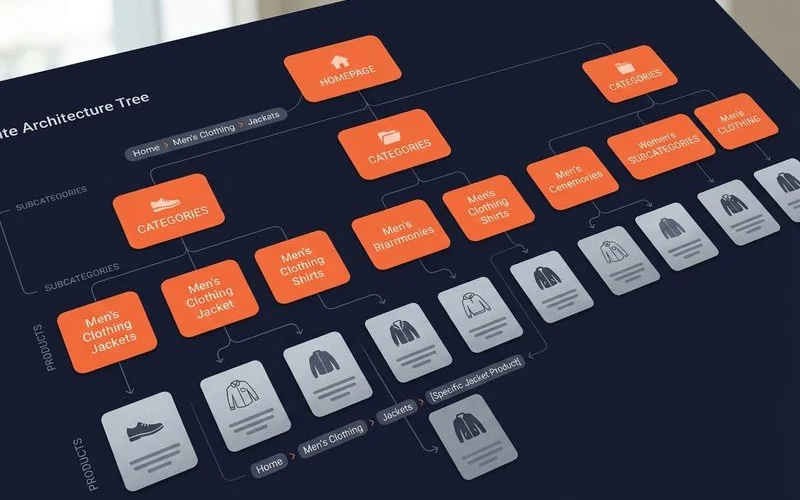
Here are the foundational rules for category structure:
- Categories sit no deeper than three levels (homepage > category > subcategory > product).
- Each category page features 200 to 400 words of substantive intro copy above the product grid.
- URL structures match the category tree perfectly, like
/category/subcategory/product-slug/. - Breadcrumbs remain implemented and clearly visible to users.
- Internal linking flows naturally from category pages to bestsellers and related items.
We always fix architectural flaws before spending a single Ringgit on content. This single step prevents wasted crawl budget.
2. Technical Setup
A clean technical foundation prevents search engines from indexing the wrong pages. We treat these specific configurations as non-negotiable for every project.
Recent data shows that a one-second delay in page load time reduces conversions by 7%. Our developers prioritise core web vitals because LCP must stay under 2.5 seconds.
The technical checklist includes specific parameters for store environments.
| Technical Element | Configuration Requirement | 2026 Impact |
|---|---|---|
| Canonicals | Every URL self-canonicals. Cross-domain is for syndication only. | Prevents duplicate content penalties. |
| Robots.txt | Disallow internal search, cart pages, and parameter URLs. | Saves crawl budget for actual products. |
| XML Sitemaps | Separate files for products, categories, and blogs. Submit to GSC. | Accelerates indexing for new inventory. |
| Hreflang | Tag stores selling to Singapore and Malaysia accurately. | Ensures the correct currency displays. |
| HTTPS | Enforce site-wide security without mixed-content errors. | Required for trust and rankings. |
We validate every technical update using Google Search Console. Mixed-content HTTPS errors will instantly fail your ranking potential.
3. Product Page Elements
Every product page must satisfy the search engine algorithm and the buyer simultaneously. Our approach focuses on elements that directly influence the purchase decision. Global e-commerce benchmarks for 2026 indicate that products with 11 to 30 reviews show a 68% higher conversion rate.
We integrate review generation directly into the SEO strategy for this reason. Read the Product page optimisation for Malaysian stores for a complete breakdown.
- Title tags follow a predictable pattern like
{Product Name} | {Brand} | {Store Name}. - H1 tags match the product name exactly, without creative variations.
- Unique descriptions contain 300 to 500 words, placing benefits above the fold and specs below.
- Product images use optimised filenames, alt text, and lazy loading.
- Schema markup covers the Product, Offer, AggregateRating, and Review fields.
- Offer schema lists pricing clearly with
priceCurrency: "MYR".
Our designers also include internal links to two or three related products. This keeps potential buyers moving through the catalog.
4. Schema Markup
Structured data translates your product details into a format search engines understand instantly. We require specific JSON-LD blocks to secure Rich Results in the SERPs. With 60% of Google searches resulting in zero-click experiences this year, visibility in featured snippets is mandatory.
Our team nests the Offer schema directly inside the Product markup. Missing schema data leaves money on the table.
Mandatory JSON-LD Blocks
We mandate the following structured data implementations for every client.
Productmarkup applied to every single item page.Offerdetails nested clearly inside the Product code.AggregateRatingandReviewtags activated wherever customer feedback exists.BreadcrumbListinstalled site-wide for better navigation snippets.Organizationdetails placed on the homepage.WebSitemarkup configured with a sitelinks search box.
Validation against Google’s Rich Results Test is a strict requirement before pushing changes live. Our developers never skip this final testing phase. Broken code harms your visibility instantly.
5. Internal Linking Strategy
Strategic internal links distribute ranking power from high-traffic pages to individual products. We find that most stores leave massive equity on the table by ignoring this flow.
E-commerce sites without clear linking structures force users to click up to five times to find a product. Our linking framework reduces that friction completely.
- Category pages link directly to bestsellers and related categories.
- Product pages link back to the parent category and two to three related items.
- Blog content uses topic-matched anchor text to link to relevant categories.
- The footer contains universal internal links to your top categories.
Faceted navigation: the universal e-commerce SEO killer
Colour, size, price, and sort filters create hundreds or thousands of indexable URLs. The fix involves canonicalising filter URLs to the parent category, disallowing them in the robots.txt file, and using parameter handling in GSC. This single fix has lifted client traffic 30% to 50% in 90 days on neglected catalogs.
The impact of managing these filter pages is immediate. We regularly see performance spike just from cleaning up faceted navigation.
6. Shopify-Specific Gotchas
Shopify’s unique architecture requires specific workarounds to prevent duplicate content issues. We deploy a specialised shopify seo checklist to manage these platform quirks. As of 2024, merchants can finally edit the robots.txt.liquid file to block unwanted crawler access.
Our specialists use this feature to block faceted navigation cleanly.
- Shopify’s editable
robots.txtis useful but limited, making a canonical strategy your primary control. - Default theme schema lacks detail, so install JSON-LD via theme code or an app like Schema App.
- Collection page intro text requires explicit configuration because many themes hide it by default.
- Internal search results pages must be set to noindex.
These simple adjustments make a massive difference in how search engines view your store. We always test the schema output after changing any theme settings.
7. WooCommerce-Specific Gotchas
WooCommerce offers immense flexibility but often struggles with speed out of the box. We follow a rigorous woocommerce seo guide to prevent database bloat. Removing unnecessary URL bases like /product/ makes links shorter and easier for SERPs to process.
Our team implements caching and database optimisation to keep page load times under two seconds.
- Product variation URLs for colours or sizes need careful canonical handling.
- The default WooCommerce sitemap often includes cart and checkout pages, which you must exclude.
- Compatibility with plugins like Yoast or Rank Math varies by theme, requiring thorough testing.
- Large catalogs suffer from performance lag without aggressive server-side caching.
Fast hosting is non-negotiable for a WordPress environment. We rely on these optimisations to outrank slower competitors. Speed directly influences your bottom line.
Bridge to the Engagement
Running through this checklist will expose the biggest opportunities in your catalog. We suggest prioritising fixes based on their potential traffic impact.
The technical foundations must be solid before you invest in new content creation. Our full audit-and-execution scope handles this entire process for you. If the workload feels overwhelming, check out our E-commerce SEO services for dedicated support on the Standard tier and above.
We manage the technical details so you can focus on fulfilling orders. It is time to turn your catalog into a revenue engine using this complete ecommerce seo checklist.
Related Guides
Common E-commerce SEO Mistakes That Hurt Rankings
Top e-commerce SEO mistakes: duplicate content, thin categories, faceted-navigation bloat, broken schema, slow product pages — with fixes.
How to Do Keyword Research for E-commerce in Malaysia
E-commerce keyword research workflow for Malaysian stores: commercial-intent keywords, Ahrefs/SEMrush process, language mix considerations.
E-commerce SEO vs Google Shopping Ads: Which Is Better in 2026?
Side-by-side: e-commerce SEO vs Google Shopping Ads. Cost-structure, time-to-revenue, sustainability, and recommended budget split for Malaysian stores.
Product Page Optimization for Malaysian Online Stores
Product-page SEO patterns: titles, H1, meta, image SEO, review schema, internal linking, RM pricing display — built for Malaysian shoppers.
Frequently Asked Questions
Is Shopify or WooCommerce better for SEO?
Both are capable. WooCommerce is more flexible for complex catalogs and custom schema; Shopify is faster to ship and has cleaner default architecture. Choose by team capacity rather than SEO ceiling — a well-run Shopify store and a well-run WooCommerce store can both rank top 3 in competitive Malaysian niches.
What is the number one e-commerce SEO mistake?
Letting faceted navigation index thousands of duplicate filter URLs. The pattern is universal: color, size, price, sort filters create hundreds or thousands of indexable URLs that dilute authority and bloat crawl budget. Canonical strategy plus robots.txt parameter handling is the foundational fix.
Do I need Yoast or Rank Math on WooCommerce?
Rank Math is the lighter modern choice and our default recommendation. Yoast is fine if you are already on it and the team is trained. Both can get the job done — the bigger issue is whether the team uses the plugin's full schema and content-analysis features rather than just the title and meta tag fields.