
E-commerce Keyword Research for Malaysian Stores
E-commerce keyword research workflow for Malaysian stores: commercial-intent keywords, Ahrefs/SEMrush process, language mix considerations.

E-commerce Keyword Research Is Not General Keyword Research
We see many store owners treat e-commerce keyword research exactly like general blog SEO.
That mistake costs them dearly.
The real dividing line between traffic and actual revenue comes down to commercial intent. Our team knows that a long-tail product query with 30 monthly searches converting at 3% easily beats a generic keyword bringing 5,000 visitors at a 0.4% conversion rate.
Since Adam Yong founded Adam SEO in 2011, tangible business results have driven every strategy we deploy. Data from 2025 shows global e-commerce volume hitting $6.8 trillion. We will break down the exact workflow that helps Malaysian SMEs capture these high-intent buyers.
Step 1: Identify Commercial Intent Modifiers
We start every ecommerce keyword research project by identifying explicit purchase modifiers.
Shoppers do not just search for generic terms anymore.
Recent 2026 data shows that AI-driven search traffic to retail websites jumped by 1,200 percent. Our data indicates this shift means buyers ask complex, conversational questions before reaching a checkout page.
You need to capture that specific intent.
- “best [product] malaysia”
- “[product] price malaysia”
- “where to buy [product] malaysia”
- “cheap [product] malaysia”
- “[product] online shop malaysia”
- “[product] [feature] malaysia”
We map these patterns against the full catalog.
Executing shopify keyword research for a standard store with 200 SKUs typically generates 1,000 to 3,000 commercial-intent keywords across these variations.
Malaysian marketplaces like Shopee and Lazada generated roughly $530 million in monthly sales locally in early 2024. Our strategy steals high-intent traffic away from those marketplace giants by targeting the specific modifiers they often overlook.
Step 2: Tooling Workflow (Ahrefs + SEMrush)
We execute a highly structured tooling workflow to find the best terms.
Using the right software saves hundreds of hours of manual analysis.
As of 2026, Semrush Pro costs around $140 monthly, but it includes an incredibly useful Keyword Magic Tool that filters directly by search intent. Our analysts also utilize Ahrefs, which recently introduced a $29 monthly Starter plan, making it highly accessible for smaller local stores.
Both platforms provide distinct advantages for uncovering hidden local demand.
Here is the exact process:
- Seed keywords: pull head terms from your category names and bestseller product names.
- Ahrefs Keywords Explorer: expand seeds with the Matching Terms and Questions reports, filtering specifically for Malaysia search volume.
- SEMrush Keyword Magic Tool: cross-reference with broader query patterns and pull their Intent classifications to confirm commercial value.
- GSC integration: pull existing query data from your own Google Search Console to surface the 100+ queries you already rank for accidentally.
- Competitor gap: feed top 3 competitor domains into Ahrefs Site Explorer Organic Keywords report to find queries they rank for but you miss.
We strongly recommend starting with your own Google Search Console data before buying premium tools.
Many businesses ignore this free resource.
Your existing rankings offer the quickest path to revenue growth. Our team relies on this baseline data to build immediate momentum.
Step 3: Malaysian Language Mix
We see agencies constantly leave 30% to 40% of demand on the table by ignoring local languages.
Malaysian e-commerce search behavior splits uniquely across English, Bahasa Malaysia, and localized Mandarin variants in Penang and the Klang Valley.
The Malaysian government recently enforced the Consumer Protection (Electronic Trade Transaction) Regulations 2024. Our clients must now use Bahasa Melayu for product listings on platforms like Shopee and TikTok Shop to avoid massive fines.
This legal shift makes targeting Malay keywords a strict business requirement.
Strategic Language Phasing
We approach this language split in three distinct phases.
The search volume varies significantly between demographics.
- Run keyword research in English first to capture the highest search volume and urban premium intent.
- Run a parallel pass in Bahasa Malaysia for the same product categories, keeping in mind that tools like Ahrefs require manual translation prompts.
- Check Mandarin variants specifically for Penang and Kuala Lumpur stores in niches like food, fashion, and beauty.
Our internal data shows that Malay query volume usually sits at 30% to 60% of the English volume.
Conversion rates on these Malay terms are often materially higher.
Lower search competition means your product pages rank faster and cheaper.
Step 4: Map Keywords to Pages
We assign every single keyword a specific home on the website.
Leaving targeting to chance creates a messy structure that confuses search engines.
A recent 2026 analysis of Google Search Console data confirmed that keyword cannibalization splits ranking authority. Our SEO audits constantly reveal multiple pages competing for the same user intent, which effectively prevents any of them from ranking well.
You must follow strict mapping rules to avoid this problem.
| Keyword Type | Page Type |
|---|---|
| Head terms (“dresses malaysia”) | Category page |
| Mid-tail with category modifier (“workwear dresses malaysia”) | Subcategory page |
| Long-tail with product specificity (“black blazer dress xl malaysia”) | Product page |
| Informational (“how to choose office wear malaysia”) | Blog content |
| Comparison (“workwear dresses vs casual blazer dresses”) | Blog content |
We monitor page position volatility closely to spot mapping errors early.
Two pages competing for the exact same primary keyword will cannibalize each other.
Google may simply choose to rank neither page.
Step 5: Prioritize by Profit Potential, Not Volume
We always prioritize keyword targeting based on actual profit potential.
The classic 80/20 rule applies perfectly here.
Just 20% of your catalog typically drives 80% of your business margin. Our experience shows that average e-commerce profit margins hover around 15% to 20%.
Keyword research priority must follow those tight margins rather than chasing vanity search volume metrics.
A high-margin item with 100 monthly commercial searches holds significantly more value than a low-margin accessory with 1,000 searches.
The Malaysian SME shortcut
Pull 90 days of Shopify or WooCommerce sales data. Identify the top 20 SKUs by revenue. Run keyword research deeply on those first. Expand to long-tail and supporting categories only after the top 20 are well-mapped and ranking.
We implement this exact shortcut for new clients to guarantee a fast return on investment.
Wasting time optimizing products that do not generate meaningful cash flow is a critical error.
Step 6: Document and Maintain
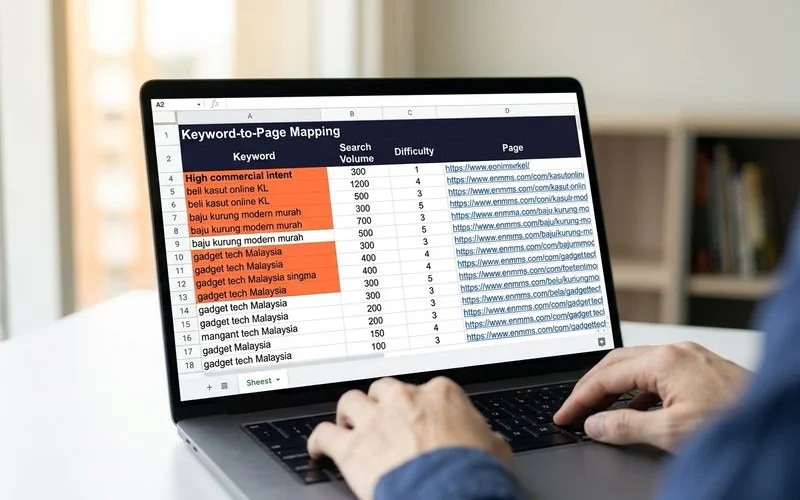
We treat ecommerce keyword research as a living system rather than a one-time deliverable.
Search algorithms and consumer behaviors shift rapidly.
The rise of AI overviews in 2026 means search result pages change almost weekly. Our tracking methodology relies on a centralized, highly structured spreadsheet.
You need to maintain visibility on all moving parts.
This living document must include specific data points:
- Each targeted keyword mapped to an assigned page.
- Current search engine rank and monthly search volume.
- Internal priority level based on margin.
We schedule quarterly refreshes to capture new product launches and seasonal demand changes.
An annual full re-run is necessary because the competitive landscape constantly evolves.
Tracking these changes ensures your store never loses its competitive edge.
Bridge to the Engagement
We use this ecommerce keyword research to feed your entire e-commerce SEO strategy. Solid data forms the foundation of every successful online store.
See the e-commerce SEO checklist for exactly how these mapped keywords integrate into daily product page work. Our technical team also relies on product page optimization to execute the final implementation patterns. Start mapping your most profitable products today to secure those top rankings.
Related Guides
Common E-commerce SEO Mistakes That Hurt Rankings
Top e-commerce SEO mistakes: duplicate content, thin categories, faceted-navigation bloat, broken schema, slow product pages — with fixes.
E-commerce SEO Checklist for Shopify and WooCommerce Stores (2026)
Complete 2026 e-commerce SEO checklist with Shopify and WooCommerce platform-specific gotchas. Site architecture, product pages, schema, internal linking.
E-commerce SEO vs Google Shopping Ads: Which Is Better in 2026?
Side-by-side: e-commerce SEO vs Google Shopping Ads. Cost-structure, time-to-revenue, sustainability, and recommended budget split for Malaysian stores.
Product Page Optimization for Malaysian Online Stores
Product-page SEO patterns: titles, H1, meta, image SEO, review schema, internal linking, RM pricing display — built for Malaysian shoppers.
Frequently Asked Questions
Should Malaysian e-commerce target English or Malay keywords?
Both. English wins urban and premium intent (KL, PJ, KLCC, Bangsar). Malay wins suburban and value-conscious intent (smaller cities, older demographics, regional shoppers). The keyword research workflow needs to cover both languages explicitly — most agencies skip Malay variants and miss 30-40% of demand.
How many keywords should a product page target?
1 primary commercial keyword plus 2-3 close variants. Don't try to rank a single product page for 10 distinct intents — Google rewards focus. Long-tail variants typically share enough semantic overlap that they rank without explicit targeting once the primary is in place.
Are long-tail e-commerce keywords worth it?
Yes — they convert 2-3x higher than head terms despite lower volume per term. The math: 100 long-tail keywords averaging 50 searches each at 8% click-through and 3% conversion outperforms 5 head terms at 5,000 searches each at 4% CTR and 1% conversion. Long tail wins on revenue.